Inspiring the next generation: taking P&O into primary schools


What happens when you introduce a classroom of primary school children to prosthetics and orthotics? Plenty of curiosity, creative ideas and some brilliant questions!
Francesca Makey, BAPO Career Outreach Officer, recently visited a primary school careers event, where children dressed up as the professionals they hoped to become. When she asked whether anyone knew what an orthotist was, only a few hands went up, a reminder of the opportunity we have to raise awareness of our profession.
Through a short presentation and the chance to handle and try on devices, Francesca introduced the children to the work of prosthetists and orthotists. The spring-loaded braces proved particularly popular! The children then drew their own prostheses or orthoses, impressing Francesca with their creativity and enthusiasm.
By the end of the session, the children had discovered two careers they might never have considered and learned how P&O professionals help people live more active and independent lives.
Reflecting on the visit, Francesca said:
“As part of the BAPO Career Outreach Team, we believe reaching school children is a great way to raise our profile and increase our workforce in the future. The more we can all attend these types of events the better chance we have, plus it is incredibly fulfilling and heart warming.”
At BAPO, we believe that introducing young people to prosthetics and orthotics can spark an interest that lasts well beyond the classroom.
Thank you to Francesca for sharing her passion and helping inspire the next generation.
Could you help put P&O on the careers map? Join our Career Outreach Team today! Contact enquiries@bapo.com for more information.
Celebrating AHP Day
On 14 October, we will join the 13 other Allied Health Professions (AHPs) across England to celebrate AHPs Day.
The AHP community makes a vital contribution to system-wide care, assessing, treating and diagnosing patients across health and social care and beyond.
AHPs Day provides an opportunity for the workforce to come together and celebrate the breadth of the professions and their collective strength. Both are central to the future of the NHS and the delivery of high-quality care across all settings.
To mark the occasion, the Chief Allied Health Professions Officer for England, Professor Suzanne Rastrick CBE, will share a message with the AHP workforce in the morning. This will be available through the Office of the CAHPO LinkedIn account and on Future NHS.
In the afternoon, the winners of the CAHPO Awards 2026 will be announced through the Chief AHP Officer bulletin. You can subscribe to the bulletin here.
We encourage members to showcase their contributions within the wider AHP workforce and multidisciplinary teams. If you are posting on social media, please tag us so we can share your activities and celebrations.
This year’s theme, ‘Celebrating AHPs Deliver’, offers a focus for discussion and sharing content. With the current AHP strategy reaching the end of its term in 2027, this is an opportunity to reflect on how your day-to-day dietetic practice aligns with its ambitions. You can read the strategy here.
The key themes to explore are:
1. An enhanced foundation theme, such as:
-
AHPs championing and promoting diverse and inclusive leadership.
-
AHPs being in the right place, at the right time, with the right skills.
-
AHPs committing to research, innovation and evaluation.
-
AHPs further harnessing digital technology and innovation through data.
2. One of the five areas of focus:
-
People first.
-
Optimising care.
-
Social justice – addressing health and care inequalities.
-
Environmental sustainability.
-
Strengthening and promoting the AHP community.
3. Interprofessional collaboration and innovation between AHPs.
Find out more about AHPs Day and this year’s theme here.
Job Advert – The Children’s Hospital at Westmead – (Australia), Head of Department – Orthotics
Job Advert – Sherwood Forest Hospitals NHS Foundation Trust – Orthotic Technician
Introducing Axel Ruiz Bermudez, BAPO Learner Champion
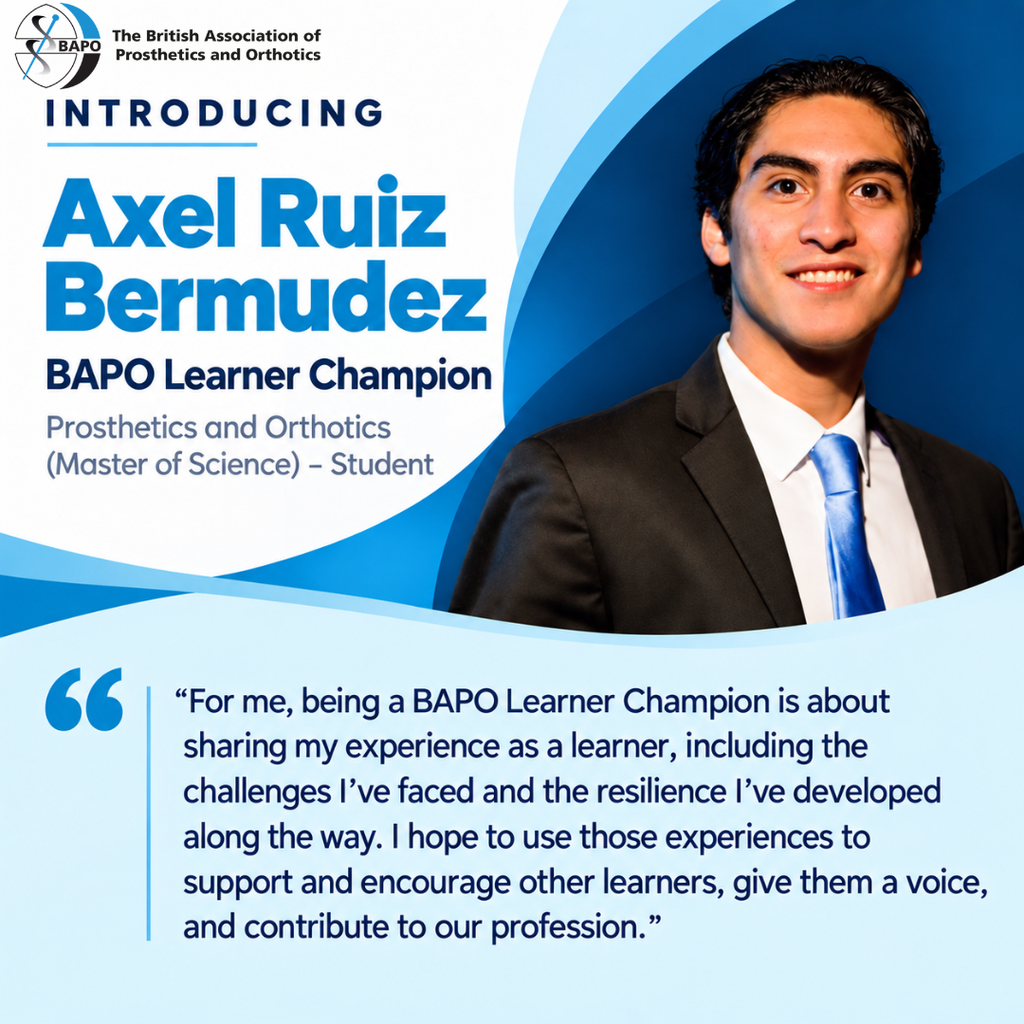
BAPO is delighted to welcome Axel Ruiz Bermudez as a Learner Champion. Axel is studying for a Master of Science in Prosthetics and Orthotics and hopes to use his experiences to support fellow learners and help ensure their voices are heard.
Through sharing the challenges he has faced and the resilience he has developed, Axel aims to encourage others throughout their learning journey and contribute to the prosthetics and orthotics profession.
Speaking about his role, Axel said:
“For me, being a BAPO Learner Champion is about sharing my experience as a learner, including the challenges I’ve faced and the resilience I’ve developed along the way. I hope to use those experiences to support and encourage other learners, give them a voice, and contribute to our profession.”
We look forward to working with Axel and welcome his commitment to supporting our learner community.
Job Advert – NHS Dumfries & Galloway – Lead Orthotist Band 7
Job Advert – Steeper Group – Senior Orthotist – Harrogate
BAPO Connected Care Webinar – Freedom to Speak Up: Championing Every Voice – The Guardian & Champion Perspective

Allied Health Professionals Federation calls for stronger AHP leadership in NHS reform
The Allied Health Professionals Federation believes the Health Bill presents an important opportunity to strengthen Allied Health Professional (AHP) leadership across the health and care system.
The AHPF, which brings together the UK’s Allied Health Professional bodies and representative organisations including BAPO, represents more than 190,000 AHPs working across health, social care, education, justice and voluntary sector settings.
AHPs play a vital role in supporting people to stay well, preventing avoidable hospital admissions, enabling timely discharge, supporting rehabilitation and helping people live independently for longer.
Their expertise is central to delivering the government’s ambitions for prevention, neighbourhood health and more sustainable health and care services.
As the NHS continues to reform, leadership structures should reflect the contribution AHPs make to patient care, service redesign and population health outcomes.
The AHP Federation is therefore calling for stronger and more consistent AHP leadership and representation within NHS decision-making structures, ensuring the perspectives and expertise of the AHP workforce are embedded in the planning and delivery of services.
We urge the Government to use the Health Bill to strengthen system and professional leadership, enabling more effective workforce planning, service improvement and delivery of high-quality care.
Strengthening AHP leadership will:
- Support better multidisciplinary decision-making.
- Improve service design and delivery.
- Help drive prevention and earlier intervention.
- Strengthen rehabilitation and recovery services.
- Maximise the impact of the NHS workforce.
This autumn, the AHPF looks forward to working with parliamentarians and NHS leaders to ensure AHPs are able to contribute fully to the future direction of health and care services.