Professional Development Opportunities: Short Courses & Webinars
At the British Association of Prosthetists and Orthotists (BAPO), our commitment to lifelong learning is central to our mission. As the recognised professional body for prosthetists and orthotists in the UK, we understand the critical role that accessible, high-quality education plays in maintaining clinical standards, advancing practice, and enabling career development.
Our educational programmes are designed to empower practitioners—whether newly qualified or highly experienced—with the knowledge, skills, and confidence to meet the dynamic needs of modern prosthetic and orthotic care. BAPO supports professionals throughout their career journeys, ensuring that learning opportunities are relevant, practical, and impactful.
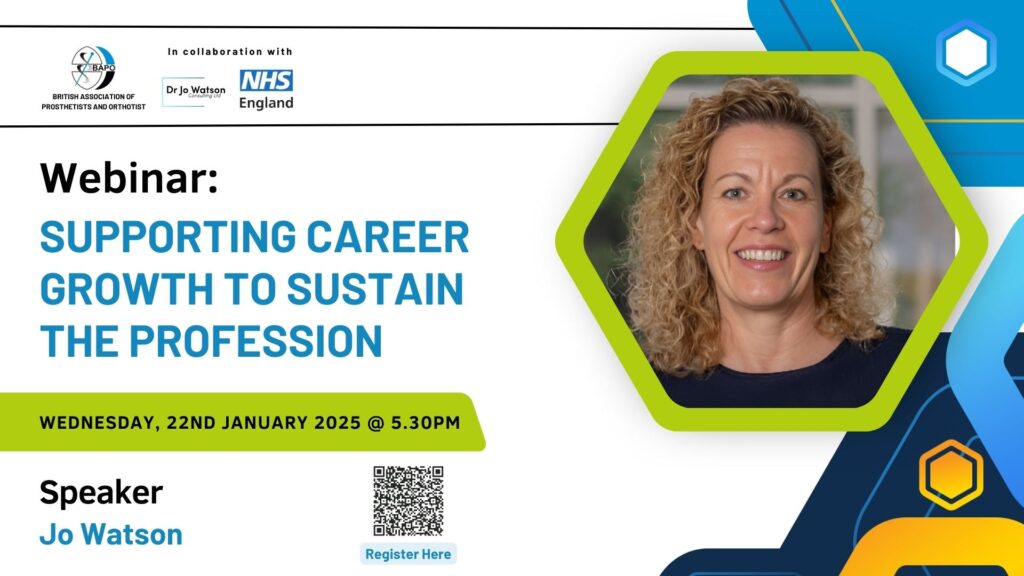
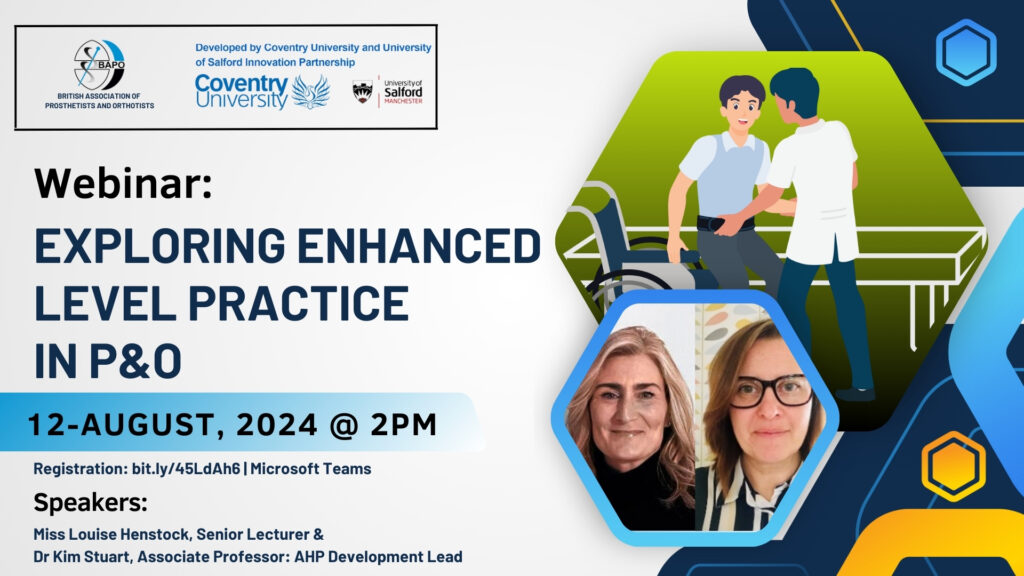
Webinars
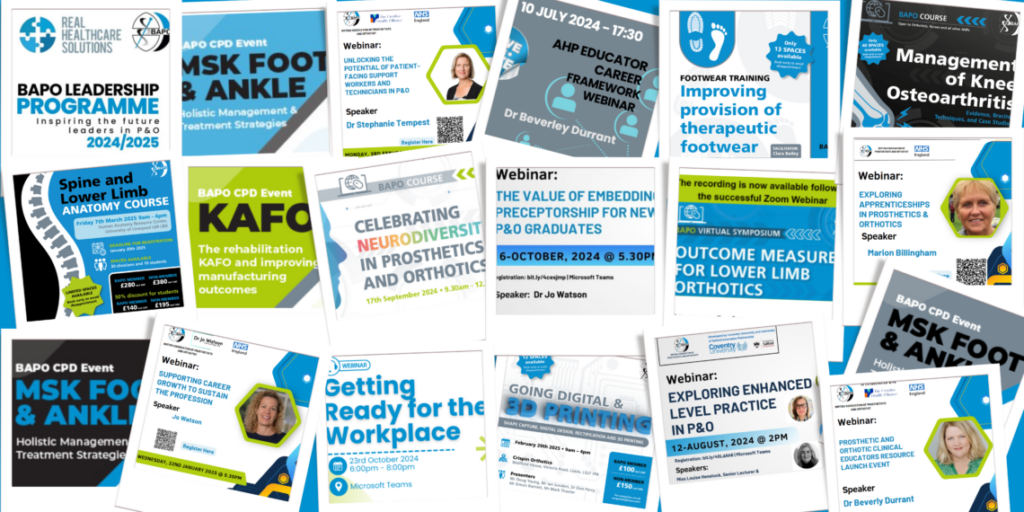
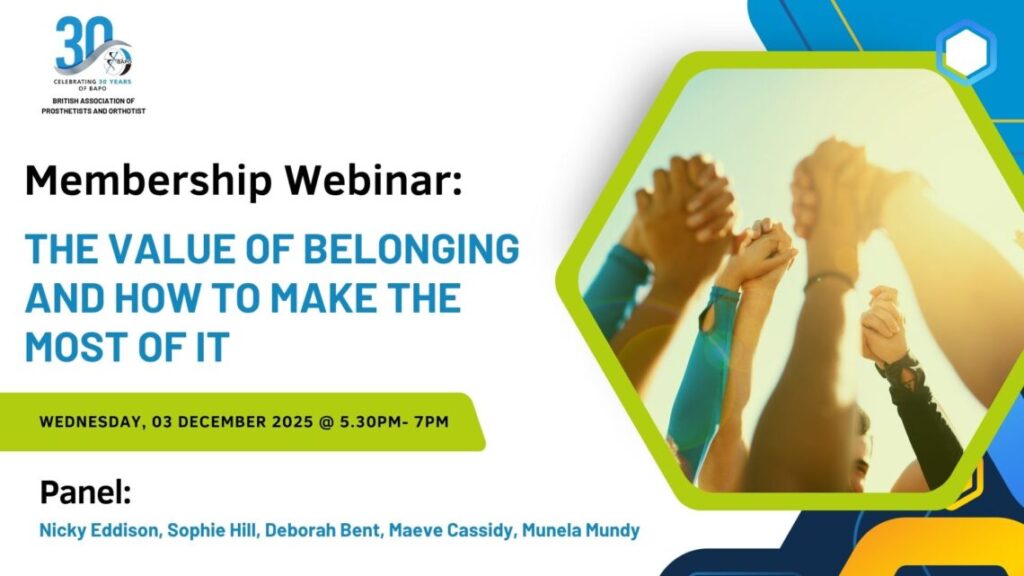
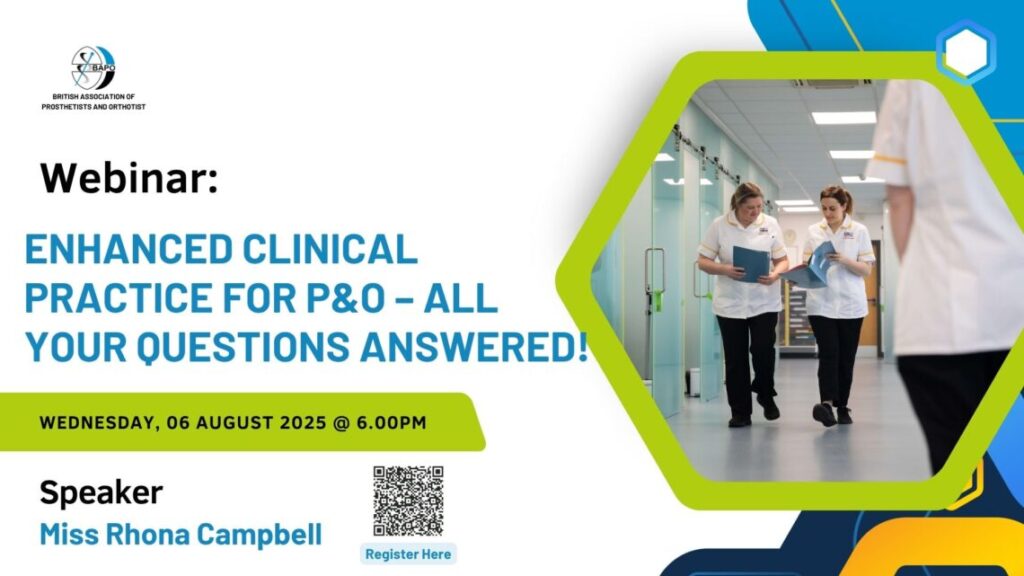
Our wide-ranging webinar series offers engaging content delivered by leading experts in the field. Topics include emerging technologies, clinical best practices, patient case studies, healthcare policy updates, and interdisciplinary approaches. These flexible online sessions provide members with the opportunity to stay abreast of current developments—all from the convenience of their home or workplace.
Structured Short Courses
In addition to webinars, BAPO delivers structured short courses aimed at deepening specialist knowledge and promoting professional excellence. These courses are grounded in real-world practice and aligned with evolving clinical demands, offering hands-on learning and peer collaboration. Participants benefit from interactive formats that encourage dialogue, critical thinking, and practical application.
Member-Led and Accessible
Our educational initiatives are shaped by the profession itself. We actively seek member feedback and encourage topic suggestions, ensuring that our content remains relevant and responsive to the evolving needs of prosthetists and orthotists. Furthermore, BAPO is proud to offer many of our webinars and learning resources at no cost or reduced rates to members, reinforcing our commitment to inclusivity and accessibility.
Through ongoing investment in education, BAPO is not only supporting the growth and development of individual practitioners but also contributing to the advancement of the profession as a whole.
Annoucement
📢 We’re pleased to announce that we are piloting a new, streamlined approach to funding orthotic education!
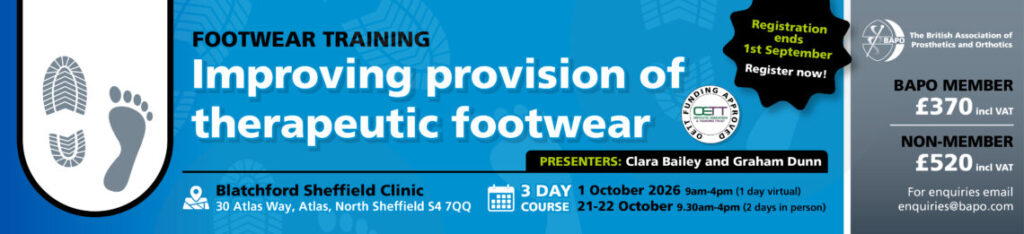
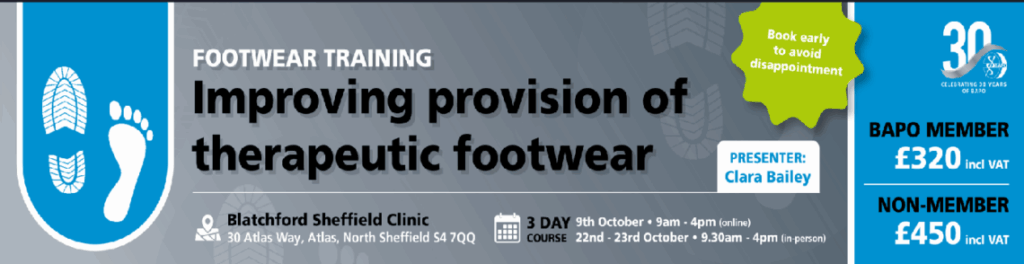
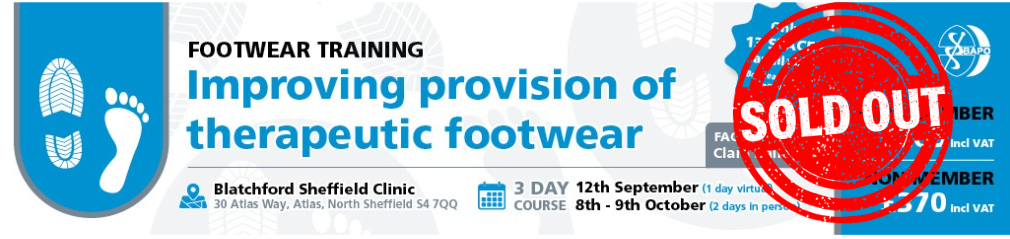
This pilot will apply to the Improving Provision of Therapeutic Footwear, Conservative Management of Spinal Fractures, and BAPO Bitesize Courses. As part of this initiative, UK orthotists, orthotics technicians, and orthotic support workers will no longer need to pay upfront for these selected courses where they are approved by the Orthotic Education Training Trust (OETT).
Instead, BAPO and OETT will work together directly to arrange funding, helping to reduce the financial burden on the orthotic workforce.
Dr Nicky Eddison, BAPO Chair,
“This pilot marks an important step toward making professional development more accessible. By removing upfront costs, we are enabling more of our workforce to engage in high-quality education without financial barriers.”
Kay Purnell, OETT Chair,
“We are delighted to collaborate with BAPO on this pilot. It allows us to test a more streamlined and supportive funding process, helping more clinicians and support staff access essential training.”
🤝 This pilot reflects our shared commitment to supporting the orthotic community and investing in its future. The next step is to ensure that training and education are protected in service contracts, enabling our workforce to thrive.
🔗 To learn more about OETT, visit: https://www.oett.org.uk/
How OETT pre-funding works
- Apply for funding via the OETT website, specifying this BAPO short course.
- The OETT Administrator reviews your application.
- If approved, OETT notifies BAPO.
- BAPO enrols you onto the course and sends your joining information.
- Travel and accommodation requests must be included in your OETT application and, if approved, are reimbursed after attendance in line with OETT Terms & Conditions.
Please note: The pre-funding pilot covers the course fee only. Travel and accommodation continue to be managed through the standard OETT reimbursement process.
Not a BAPO member?
Eligible practising Orthotists and Orthotic Support Workers working in the UK can still benefit from OETT funding. OETT will fund up to the BAPO member course fee, and BAPO will invoice non-members for the remaining balance.
We look forward to welcoming you to this course and supporting your continued professional development in spinal fracture management.
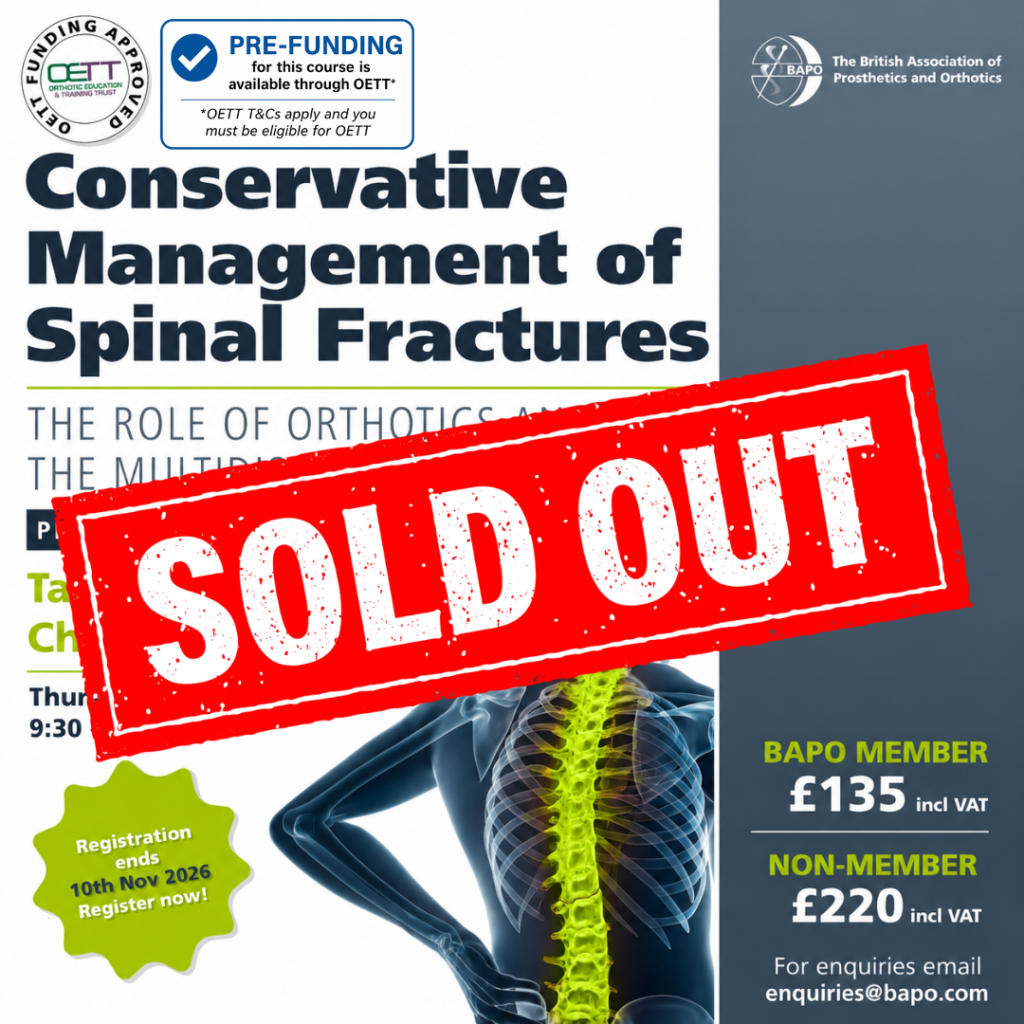
Course description:
Conservative Management of Spinal Fractures : The Role of Orthotics and the Multidisciplinary Team– A one day course
This course provides a comprehensive understanding of the orthotic management of spinal fractures. There is some focus on collaborative care involving all AHP’s working with patients who have sustained vertebral fractures, in both inpatient and outpatient settings.
Will give suggestions and tips to change/improve pathways at local Trusts, and to upgrade spinal referrals. The spinal referral examples sent out by BAPO will be used, to enhance the outcome and treatment of the spinal injury patient group.
Course aim:
Insight into assessment, decision-making and application of spinal orthoses. Strategies to support patient compliance and optimise outcomes through interdisciplinary communication. The overall goal is to give the participants more confident and knowledge on how to manage patients with spinal fractures.
Learning Outcomes:
Understand Biomechanics of different spinal fractures and spinal orthoses.
Identify what makes a fracture stable or unstable.
Identify indication of spinal bracing (and when NOT to brace a spinal fracture) backed by the evidence that is out there
Communicate and collaborate more effectively with the wider AHP team in the management of spinal fractures
Understand better what the different terminology means and classification of fractures.
Apply patient-centred approach to improve compliance and comfort with orthotic treatment
Appreciate the role of orthotic intervention in the conservative management of spinal fractures.
Intended Participants:
☒ Orthotists
☒ Orthotic support workers
☒ Other: OT’s, Physio’s, Dr’s, Consultants. Any AHP’s involved in the treatment of patients with spinal fractures.
Course timings: registration at 09:00, start 09:30, finish by 15:00
We encourage practising Orthotists or Orthotic Support Workers, who must be working in the UK, to apply for reimbursement from OETT (The Orthotic Education and Training Trust). This course has been approved for 100% funding by OETT for BAPO members, subject to the OETT Terms and Conditions. Funding includes the course fee, travel, and accommodation.
Course fee funding for non-BAPO members would be at the BAPO member rate for practising Orthotists or Orthotic Support Workers, who must be working in the UK only.
Applications can be made via the online applications link on the OETT website: www.oett.org.uk
Requests for reimbursement must include evidence of reflective learning/CPD.
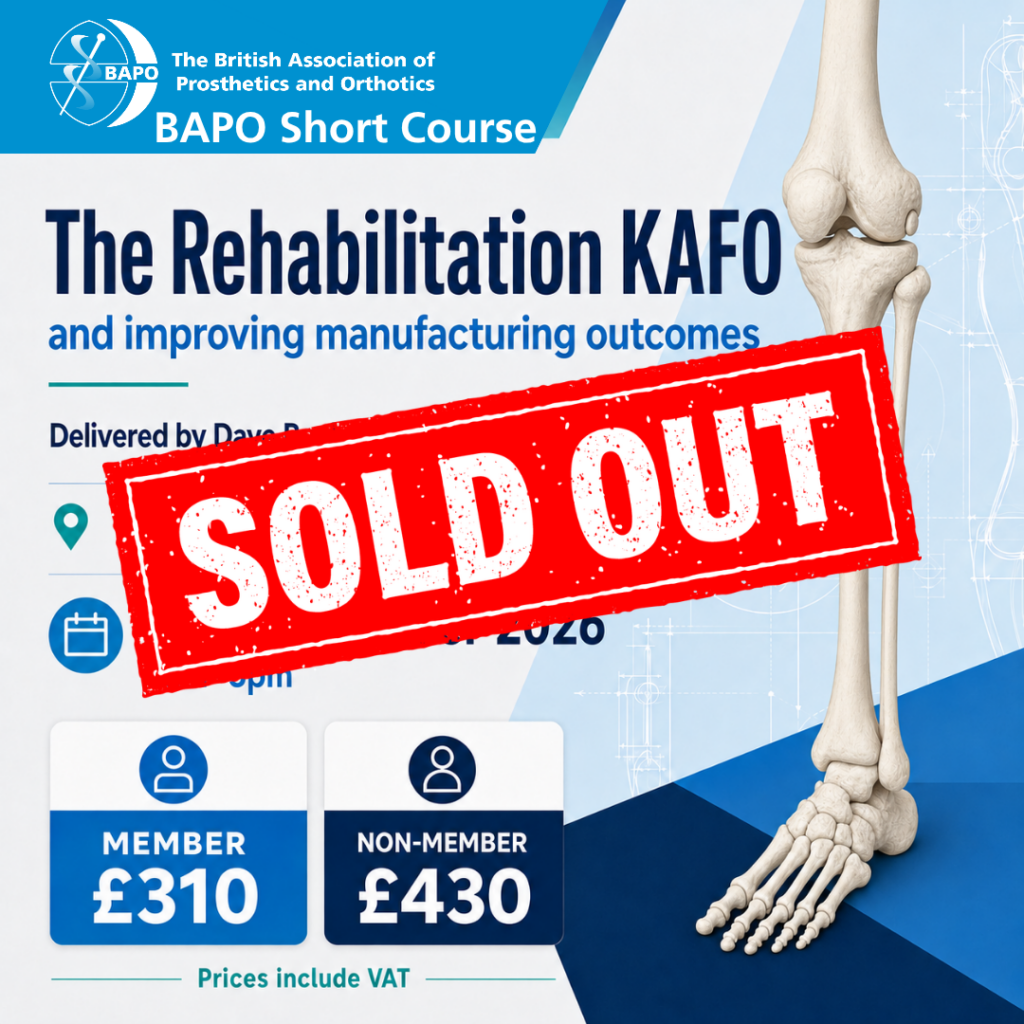
Course description:
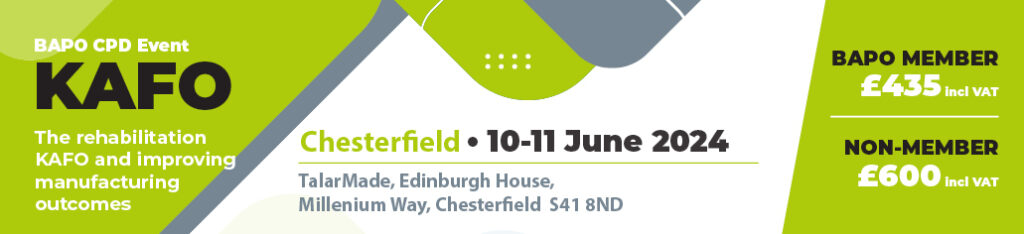
The Rehabilitation KAFO and improving manufacturing outcomes– A two day course
The prescription of Knee Ankle Foot Orthoses (KAFOs) often presents challenges for those lacking extensive experience, whether in understanding the rationale behind prescription, design, and alignment, or in effectively communicating these needs between clinical and technical staff. Additionally, manufacturing KAFOs can be complex, with technical staff sometimes struggling to grasp various aspects of the process.
Course aim:
This course aims to bridge the gap in information exchange between different professional groups within the industry, addressing challenges stemming from a lack of experience and confidence. By simplifying the patient journey and technical process, we seek to save time, money, and improve consistency in practice and outcomes, both clinically and in manufacturing.
Learning Outcomes:
Participants will gain knowledge in the following areas:
Values-Based Healthcare and the client journey. Measuring change.
Physical and biomechanical background relevant to lower limb orthoses and KAFOs more specifically.
Understanding basic presentations and making appropriate design choices.
Overview of locked, posterior offset, and optimisable stance stabilised KAFOs.
Conducting assessments and making informed component choices.
Appraising existing KAFO designs.
Considering social and health status factors in KAFO prescription.
Manipulating Ground Reaction Force (GRF) for optimised outcomes and increased stability or increased input.
Manual shape capture techniques, including corrections and alignment.
Preparation of casts for ease of use by technical staff.
Building Line of Progression or anatomical KAFO designs.
Efficient preparation time shortcuts for technical and clinical staff.
Conducting test fittings and implementing fitting tips and tricks.
Intended Participants:
☒ Orthotists
☒ Orthotic technician
☒ Orthotic support workers
☒ Other: This course is designed for Technicians, Orthotists and Support Workers, with particular emphasis on the synergy between Technician and Orthotist teams. Collaborative participation is encouraged to maximize learning outcomes and practical application. Please note: This course is not available to Students.
We encourage practising Orthotists or Orthotic Support Workers, who must be working in the UK, to apply for reimbursement from OETT (The Orthotic Education and Training Trust). This course has been approved for 100% funding by OETT for BAPO members, subject to the OETT Terms and Conditions. Funding includes the course fee, travel, and accommodation.
Course fee funding for non-BAPO members would be at the BAPO member rate for practising Orthotists or Orthotic Support Workers, who must be working in the UK only.
Applications can be made via the online applications link on the OETT website: www.oett.org.uk
Requests for reimbursement must include evidence of reflective learning/CPD.
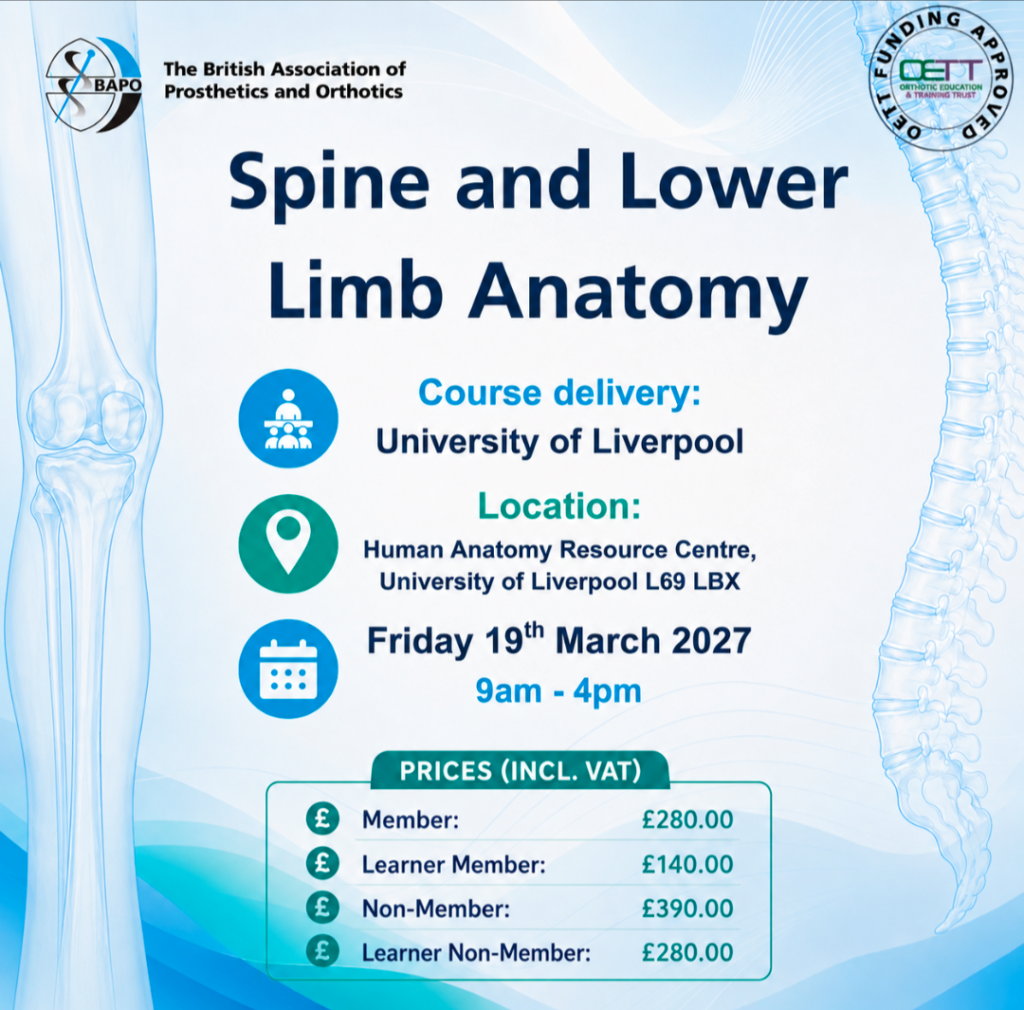
Course description:
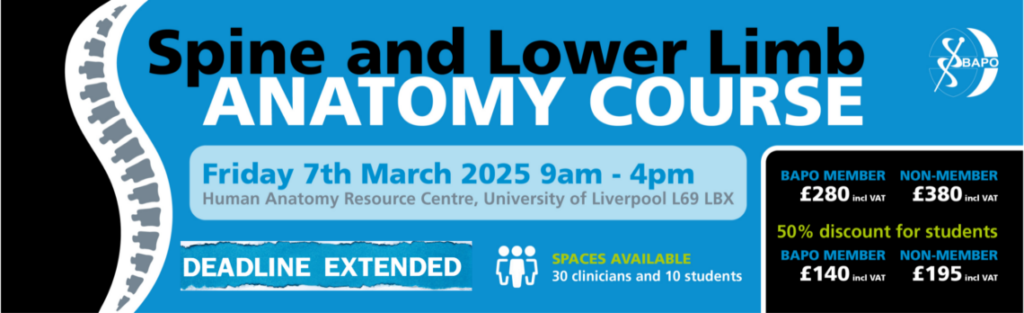
Spine and Lower Limb Anatomy Course
Course aim:
The course represents an exciting opportunity for Orthotists and Prosthetists to gain a unique insight into the human body using cadaveric material and the latest in digital technology.
The morning session will focus on the spine, hip and thigh and the afternoon session will examine the knee, lower leg and foot. You will be able to refresh your anatomical knowledge by attending a lecture by a resident academic before visiting the laboratories, where anatomy demonstrators will be on hand to assist you in examining the cadavers. Here, you will be able to gain a thorough understanding of the complete anatomy and apply it to every day clinical practice.
Learning Outcomes:
This event aims to equip clinicians with the knowledge of the spine and lower limb anatomy required to effectively treat various pathologies in clinical practice. The course content will concentrate on joints, muscle attachments, nerves, and the circulatory system and will be delivered through lectures and prosections.
Syllabus
• Registration and introduction
• Anatomy of the spine, hip and thigh (Lecture)
• Prosections of the spine, hip and thigh (practical session)
• Lunch
• Anatomy of the knee, lower leg, ankle and foot (Lecture)
• Prosections of the knee, lower leg, ankle and foot (practical session)
• Evaluation and conclusion
Intended Participants:
☒ Orthotists
☒ Prosthetist
☒ Other: Learner
Course timings: registration at 09:00, start 09:30, finish by 16:00
We encourage practising Orthotists or Orthotic Support Workers, who must be working in the UK, to apply for reimbursement from OETT (The Orthotic Education and Training Trust). This course has been approved for 100% funding by OETT for BAPO members, subject to the OETT Terms and Conditions. Funding includes the course fee, travel, and accommodation.
Course fee funding for non-BAPO members would be at the BAPO member rate for practising Orthotists or Orthotic Support Workers, who must be working in the UK only.
Applications can be made via the online applications link on the OETT website: www.oett.org.uk
Requests for reimbursement must include evidence of reflective learning/CPD.
We’re planning a hands-on anatomy refresher course for clinicians and students in Prosthetics & Orthotics—and we want your input.
This course will bring together expert-led teaching, cadaveric prosections, and digital tools to revisit clinically relevant anatomy in a practical, applied way.
Help us shape the course by telling us which anatomical areas you’d find most valuable.
Complete the short survey and register your interest—spaces will be limited.
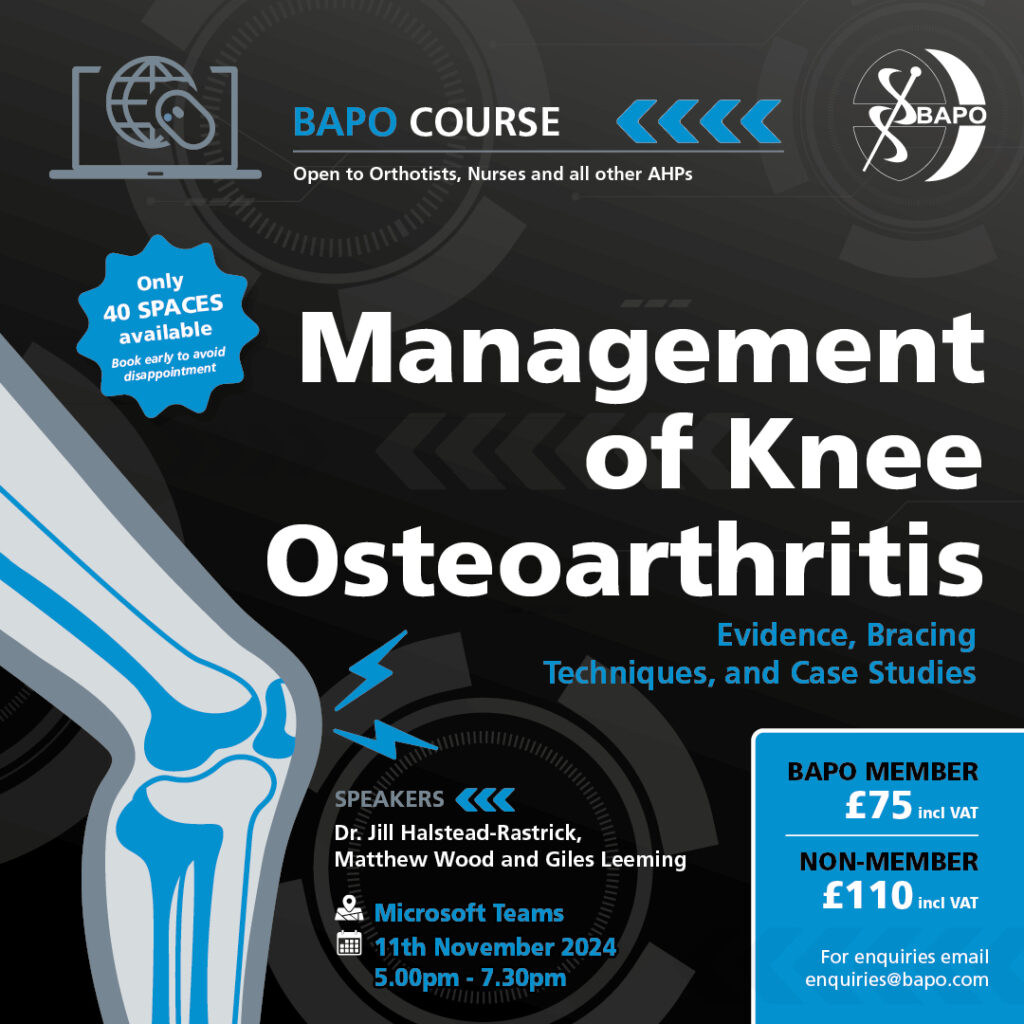
Conservative Management of Knee Osteoarthritis: Evidence, Bracing Techniques, and Case Studies
Current Evidence and NICE Thresholds
Speaker: Dr. Jill Halstead-Rastrick
Description: Exercise and weight loss are the first-line treatments for knee osteoarthritis (OA). Alongside this, knee braces offer people with knee pain an alternative treatment option, especially for those where first line treatments or knee surgery are not possible, but the evidence is limited.
Knee bracing was reviewed as part of the recent OA NICE guideline update and this will be discussed.
Auditing Knee Brace Provision
Speaker: Matthew Wood
Description: During the Covid-19 pandemic, when elective surgery was suspended on the NHS, the waiting list for total knee replacements got longer with fewer resources available to manage deteriorating patients. We designed an audit to propose appropriate patients are offered an orthotists’ assessment whilst they wait, and a protocol was agreed. This provided us with an opportunity to prove that the research supporting knee bracing could provide benefits to quality of life, improve outcomes, and reduce costs.
In this session, we wish to share the learning from this audit and provide a framework for those interested in addressing local barriers to provision.
Biomechanical Principles and Brace Selection for OA Bracing
Speaker: Giles Leeming
Description: Bracing for knee osteoarthritis relies on biomechanical principles to manage the osteoarthritis (OA) by redistributing the mechanical load across the knee joint. Understanding these principles is crucial for selecting and customising braces to cater to individual patient needs, ensuring effective pain management and functional improvement. Giles Leeming will go through these principles, and will also delve into the principles for accurate brace selection; and present case studies
Giles will also introduce Allan Henshall, a bi-lateral brace user and will also present problem-solving through various case studies.
Past Short Courses & Webinars